Tuesday, February 28, 2012

Tara Donovan


Tara Donovan’s Brilliant Drawings Made of Thousands of Pins


A STUNNING DEPARTURE FOR AN ARTIST SAINTED BY THE MACARTHUR FOUNDATION’S "GENIUS GRANT."

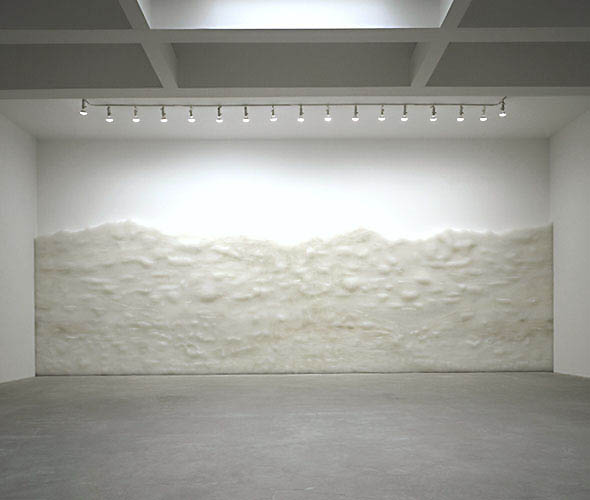
Viewed from afar, Tara Donovan's artworks often look like massive pieces of moon-scape, dropped straight from space into a pristine white gallery. It's only when you draw closer that you realize these pieces aren't alien at all: They're made of simple, everyday stuff, whether it's thousands ofpencils or coffee cups or drinking straws gathered into hills and clouds occupying entire rooms. Donovan, a certified MacArthur Foundation genius, is the closest thing the art world has to a true alchemist, transforming the detritus of everyday life into sheer beauty.

In her latest show, at Pace Gallery in New York through March 19th, Donovan departs from her usual formula of sculptural installations that take up entire rooms. Instead, she's using thousands and thousands of push-pins to create images up to eight-feet tall. Viewed in person, the pieces shimmer and dance; formally, they look like homages to minimalist gods such as Agnes Martin or Kasimir Malevitch.

But where those works can be chilly and almost devoid of a human touch, you can't help but feel Donovan's hand in these pieces, meticulously pushing each one of those pins into place, backing up to gauge her work, and starting all over again.

Here, we present a slideshow of her works. But if you're in New York, you gotta see these for yourself.

Monday, February 20, 2012

Brody Condon


(1) Each pole must stay connected at all times, creating a line of energy the length of the poles.
(2) The movers should move slowly and constantly in a circle, like a blender with the center dancers swirling in place. They should imagine this movement to be the engine of a Dimensional Stability Machine, if the machine stops our dimension evaporates.
(3) Any viewers are to be regarded as ghosts on another plane of existence; they can be seen but not touched or spoken to.

Tuesday, December 6, 2011

tower blox - BBC 25 November 2011

Viewpoint: Could people learn to love tower blocks?

Tower blocks at Park Hill, Sheffield


1945 saw Britain as victors and victims - lost men, lost skills, lost industry, and, most significant, a critical shortage of homes.

Once tower blocks were the answer to a housing crisis but many people came to hate them. With Sheffield's Park Hill estate being refurbished for its 50th birthday, can people learn to love them again, asks architect and broadcaster Maxwell Hutchinson.

The new Labour Prime Minister Clement Attlee was a democratic victor but a scapegoat for government's failure to come up with solution to the critical homes crisis.

Homes were the most pressing and seemingly insoluble of all post-war social issues. There was no labour force, no bricks, and acres of still-smoking slums.

Enter continental pre-war modernist architecture, forged in the creative minds of Le Corbusier, Walter Gropius and others, and kept alive in the fertile minds of Britain's young architects, who had been plucked away from their studied enthusiasm for the new modernism to fight a war.

Find out more

  • Archive On 4 - Rebuilding Britain For The Baby Boomers, presented by Maxwell Hutchinson, is on BBC Radio 4 on Saturday 26 November at 20:00 GMT

They returned, not demoralised by the fighting, but with a fervent zeal for modernism. They brought with them a solution, and government loved it. Housing problem? What problem? Build them high, make them in factories, and slot them into the waste lands of easily cleared slums.

There were no Nimbys [not-in-my-back-yard] then. No pressure groups, no conservation areas - British towns and cities were one huge brownfield site.

So the British tower block was born. Glasgow rebuilt a city with more tower blocks than any other city in Europe. It's still the case. London's East End cheered as cloud-scraping towers provided modernity, inside lavatories, central heating, Formica, and hot baths.

Woman looks out from London tower blockTower blocks were the answer to a major housing crisis

But this vision did not last long. The middle class saw tower blocks as ghettos that they would rather pass by. Post-war families boomed, but the ideologically inspired dreams of cheap, quality, high-rise housing started to be neglected and demonised.

The tower block started to be seen as all that was misguided about post-war Britain. Maintenance was often abysmal - lifts failed, rubbish chutes were blocked, garages were burnt by vandals.

Notable high-rise blocks

Park Hill Estate, Sheffield
  • Beetham Tower, Manchester (2006): UK's tallest residential building
  • Trellick Tower, London (1972): Erno Goldfinger's building is now popular with residents
  • Park Hill estate in Sheffield (1961): Now Grade II* listed and being refurbished
  • Robin Hood Gardens (1972): Praised by some, but due for demolition

There had been doubts, but events triggered by an early morning cup of tea in a tower block in east London on 16 May 1968 turned the UK wholeheartedly against high-rise living and all that it stood for.

Ivy Hodge lived on the 18th floor Ronan Point, a 22-storey tower, named after Harry Louis Ronan, a chairman of the London borough of Newham's Housing Committee, which had opened on 11 March 1968.

As Hodge struck a match to light her stove, a gas explosion ripped the corner out of the tower. That corner fell down like a pile of loosely stacked tiles.

That was how the block and many more like it were built, story-high, load-bearing concrete panels stacked sky-high with what proved to be appallingly badly made joints. Hodge survived but four residents died and 17 were injured in the disaster.

High-rise challenge

By Bill Price, structural engineer, WSP Group

In the 50s and 60s, council housing was about economy and innovation and, to some extent, experimentation in design.

It was the early days of pre-cast concrete and the focus was to find quick ways to build things. For example, high alumina cement (HAC) was used to try to make concrete set faster. This had some detrimental effects - there were some collapses but it wasn't a major issue.

Concrete was cast on wood/wool slabs made of compressed timber fibres, which remained in place. But with this technique, the concrete didn't set so well. In many of buildings, concrete slabs were not connected in a robust way.

As a material, concrete has moved on significantly - today, we use super high-strength concrete. In the 1960s concrete strength in high-rises was 40 Newton, now buildings such as the Shard in London, or some high-rise buildings in the US, 100N-110N has been used - double or triple the strength.

At the time, there was also little consideration of long-term maintenance, the buildings were leaky, draughty and this led to degradation issues. Now we think more about longevity - keeping the weather out, for example - but there is still some way to go.

Hodge's cup of tea had brought down more than the corner of one tower - it shattered the public's confidence in all high-rise dreaming.

The innate enthusiasm of the English for vernacular architecture took hold of the nation's mood - all would now be comfortable brick, near the ground with pitched roofs, garden front and rear. It would be just like good old England.

Such was the government's over reaction at the events in Newham that they tore up their high post-war ideals and started an orgy of tower destruction.

The undeserved perception of failed idealism was celebrated by spectacular displays of demolition pyrotechnic. The tower block had failed and picnic parties sat on London's Hackney Marshes as tower after tower exploded and crashed into a pile of wasted idealism and dreams.

But all was not lost. Some energetic and visionary young architects and property developers have seen merit in the towers in the 21st Century.

Many of the old towers are still there - their very existence proving they are intrinsically sustainable. A tidy-up of the common areas, new lifts, a permanent concierge, entry-phone system and high-rise slums could become desirable homes.

London's famous Trellick Tower, by the architect Erno Goldfinger, is now a 30-storey style pile. That goes for towers in Glasgow, now swathed in multicoloured insulating overcladding.

Not all concrete ideals of the post-war building boom have survived, Alison and Peter Smithson's polemic Robin Hood Gardens in east London is not long for this life, despite the protestations of the architectural elite. Concrete cancer, poor maintenance and the vandalism of social discontent have had their way - down it will come.

Ronan Point

  • Opened in March 1968 in Newham, east London
  • Built using prefabricated concrete panels bolted together
  • Gas explosion sparked collapse of one corner in May 1968
  • Four people were killed and 17 injured
  • Lifts had already broken down, impeding evacuation
  • Tower was rebuilt but demolished in 1986
  • Building regulations were tightened after an inquiry

But there is nothing intrinsically flawed with the idea of high-rise living. Sustainability, good maintenance, careful management and a sense of ownership can make things work.

If the lift works, towers are particularly suitable for the elderly - great views, peace and quiet, neighbours who can still remember the post-war devastation.

Towers also work for the young - they are convenient, give a good leg-up on the housing market, and, with good neighbours, great fun. There is plenty of time to have children and move into a predictable estate on the outside of town. In the meantime, one can enjoy life with one's head in the clouds.

The tower of homes is making a refreshing comeback. New technology means faster, more reliable lifts, and acoustic improvements mean greater privacy.

Beetham Tower in ManchesterThere is now a new generation of high-rise

New materials and structural engineering innovations produce a new architectural language for the tower. Although concrete is still an essential part of the buildings' structure, it is no longer a singular cladding material.

The new towers benefit from the introduction of colour and texture. The tower prejudice has all but gone - today's urban world is once again reaching for the sky.

Monday, November 28, 2011

Holy Grail Obstacle Course

My first proposal for a reenactment:

Plan for Crit


In the next few weeks I would like to host a reenactment of a sequence of scenes from Indiana Jones and The Last Crusade. The scene is the pinnacle of the film where Indiana Jones, his father Henry Jones, his colleague Marcus Brody and their associate Sallah reach the final resting place of the Holy Grail. Along with the desire of the Holy Grail of the Nazis, and to save his father’s life, Indiana Jones is forced to proceed along the ancient obstacle course set in place to deter pilgrims of the Grail quest from obtaining the eternal life giving cup. Through careful research and study over the years, his father has acquired a number of vague clues to successful passage through the tests and traps set in place to kill contenders.


For this crit I am presenting an edited clip of the scenes, and an installation of the props I will use in the lo-tech reenactment. This will include some round cardboard blades covered in tinfoil, a floor plan of letters, a lion’s head and sesame seeds.I would like to host this reenactment in the basement of the Vic. I will use the lighting to stage a certain filmic quality, and the music technology and a projector to play the edited version of the scenes during the reenactment. I will invite classmates, other students, and anyone in the Vic that day to participate in the crowd or to be one of the contenders. The participant who ‘runs the obstacle course’ has the choice to wear an Indiana Jones style hat, and can stick to the script of the film, using prior knowledge of the film, or with the help of the projection, or they can interpret the course as they like.


This piece will hopefully allow me to progress my experience of the issues surrounding participation, as I will act as director in so much as I will install the course, but the participants will be free to choose how to use the course.


Potential Problems on the day:

  1. No-one will come, (I plan to put up posters, see poster)
  2. I will find difficulty explaining to participants, esp if several people, what my intentions are, as I am not yet sure
  3. The scene which lasts about 8 minutes might be too long to hold the attention of the participants. (editing would have to consider the most relevant scenes detrimental to the execution of the exercise)


I have previously been preoccupied with the idea of working outside the school, with already formed groups, especially in non-art areas. However, while still within the art school, I have decided that it would beneficial to take advantage of the supportive, open and enthusiastic world that the school provides, and strip my practice back to the experimental stage.


Documentation


I plan to either film this myself or ask someone with better skills and/or camera to film it for me. I think I may have to do the course myself, I’m not sure if some participants will let me get away with not doing it. Although this is not a performance, and I would rather not blur the lines of intention. I will also use photography as I hope the course will be run more than once, so I will have opportunity to film and photograph. I am aware that sound is particularly difficult to capture in a large space with lots of people, so I will need to borrow a sound recorder form EMS. I am not sure if I would attach it to each contender as they run the course or not.


In an exhibition situation, I would show this work without the props, and on two screens. One screen would be the original film, one would be the footage I make alongside, with the audio at the same place. The footage film may be partly or all stills, depending on the quality of the filmed footage.


Please take part in:


HOLY GRAIL

OBSTACLE

COURSE


Inspired by Indiana Jones and The Last Crusade


Downstairs in The Vic

TIME, DATE, Clare Marks

Reenactments

Extracts from the paper:

From Beyond the Grave of the Politics of Re-Enactment
Text / Pil and Galia Kollectiv


Art in the period of its dissolution, as a movement of negation in pursuit of its own transcendence in a historical society where history is not yet directly lived, is at once an art of change and a pure expression of the impossibility of change.
—Guy Debord, Thesis 190, The Society of the Spectacle1

Guy Debord's thesis number 190 concisely defines the paradox at the heart of twentieth-century art practices—the demand for an impossible permanent revolution, the mediation of an unmediated, authentic experience, and the constant pull of both past and future, progress and decadence. The recent spate of artists' re-enactments of historical events and performances seems caught up in this dialectic, haunted by Debord's paralyzing circular discourse. In his writing about history and time, Debord claims that modern time, in the wake of the domination of linear history, is subordinated to pseudo-cycles of work and leisure. Fads, consumerist seasons, remakes, and retro fashions are, in his view, imposed by capitalism on history. Are we therefore to see artistic re-enactments as logical conclusions of the spectacle's repetitive imperative?

Melanie Gilligan writes in her essay on performance and its appropriations, "Which practices involving re-enactments might be retrograde withdrawals from new aesthetic and political struggles, and which others are catalysts for them?"

Jeremy Deller, stills from The Battle of Orgreave, DVD, 2001, 62:37 minutes (directed by Mike Figgis; commissioned and produced by Artangel, London; photo: Martin Jenkinson)


Andrea Fraser, (Kunst Muss Hängen) Art Must Hang, 2001, DVD, 32:55 minutes (courtesy of the artist, Friedrich Petzel Gallery, New York, and Galerie Christian Nagel, Köln/Berlin)


Thomas Struth Family Portraits


I usually make a choice for the location, and then people can position themselves on the stage that I’ve selected - which most of the time is where they live. I ask people to sit however they want to sit, or stand. Its part of the system that inevitably people sit or position themselves according to the dynamic of the moment and whoever they want to be close to…it represents the dynamic of the moment in the group.

Wednesday, November 23, 2011

Utopia Station

friezearticle

50th Venice Biennale

VENICE, VENICE, ITALY

image

The opening days of the Venice Biennale were so hot that it felt as if everything was about to melt like scoops of ice cream in the sun. Nowhere was this feeling more acute than at ‘Utopia Station’, curated by Molly Nesbit, Hans Ulrich Obrist and Rirkrit Tiravanija. In contrast to Gabriel Orozco’s delicately curated space, ‘Utopia Station’, also situated at the far end of the Arsenale, is full to the point of bursting. Works by more than 60 individual artists, architects and artists’ groups, along with posters by another 100, are wrapped in and around a vast plywood ‘platform’ designed by Liam Gillick and Tiravanija. This construction incorporates several rooms with video projections, areas for the visitors to lounge and hang out, and a small stage where talks and lectures are planned throughout the duration of the Biennale.

‘Utopia Station’ presents itself as a functional neighbourhood open to social interaction, complete with a garden with funky communal showers designed by Tobias Rehberger, Padre de la Fontana (Father of the Fountain, 2003), ecological toilets designed by Atelier van Lieshout (Scatopia, 2002), its own web radio station (Zerynthia, in collaboration with Franz West), and a stilted hut where one might take a quick nap should it all become too exhausting (Billboardthailandhouse, 2000, by Alicia Framis). The concept of the station is an offshoot of Tiravanija’s nomadic roaming around the world and is more a junction, or a meeting-place, than a stop en route to a predetermined destination. The project here is not finished, but the interim culmination of a series of events and seminars that will see two more stations established at the Haus der Kunst in Munich this autumn and the spring of next year.

Intended as a place where the notion of Utopia can be collectively considered, many of the works and projects included in ‘Utopia Station’, such as Martha Rosler and the Oleanna group’s collaborative investigation of the term, are concerned with generating relationships between people. Nicolas Bourriaud has described this kind of art production, ‘whose main feature is to consider interhuman exchange an aesthetic object in and of itself’ (Postproduction, 2002) as ‘relational aesthetics’.

Although utopian thought both criticizes existing social forms and tries to think of new ones, it has always been attacked for concentrating its concerns in the realm of fantasy. Elmgreen & Dragset’s contribution to the show, Spelling U-T-O-P-I-A (2003), gently mocks this problem. During the opening weekend two successive monkeys tried, as the title suggests, to spell out ‘utopia’ using enlarged dice inscribed with the relevant letters. But as the monkeys’ attempts to arrange the letters in the right order failed, so - the artists suggest - real Utopia is always just beyond the grasp of human beings.

‘Utopia Station’ is a far cry from the extreme order and stability that characterize Thomas More’s ideal society, famously described in the book that introduced the word into popular usage, Utopia (1516). The show is probably closer in spirit to the temporary utopias of rock festivals or carnivals, and in this sense Venice, with its strong libertarian traditions, is the perfect setting. The section’s most striking feature, however, is its sense of chaos. Though not as radical as Carsten Höller would have liked - his contribution, No Names (2003), proposed to not reveal any of the participating curators’ and artists’ names in order to encourage a discussion based on the actual works on display - individual works lose out in the organic mix of the whole. Making literal the motif of entropy, Carl Michael van Hausswolff and Leif Elggren could be seen shredding and then pulping copies of More’s book, producing new sheets of handmade paper as part of their project The Annexation of Utopia by the Kingdoms of Elgaland/Vargaland (2003).

The sheer volume of artworks and information is both the weakness of ‘Utopia Station’ and its strength. There is a danger that the overload becomes just too much, causing a communication breakdown and thus jeopardizing the social relations that it is trying to facilitate. But then again, this simultaneous construction and wrecking might be the point. The moment when attempts at establishing real utopias go wrong is usually the point at which they become permanent.

Jacob Dahl Jürgensen

from http://www.frieze.com/issue/review/jacob_dahl_juergensen/

New Public Art: Redefining or Reconsidering Community-Based Art? Elize Mazadiego

I have extracted some passages from an essay by Elize Mazadiego which I found while researching my Critical Journal:

The term “new genre public art” sprang out of the 1991 exhibition program Culture in Action: New Public Art in Chicago. Following this was an abundance of artworks, projects, exhibits, and texts that defined “new genre public art” as a form that fosters an often temporary collaboration between artist and communities in the making of locally-specific, sociopolitically oriented works. In contrast to traditional public art (that is, a public siting of sculptural forms and installations) the new genre foregrounds community, and its interaction with the artist, as the artwork....

....Miwon Kwon’s 2004 publication One Place After Another: Site Specific Art and Locational Identity is critical to this conversation as it gives a historical framework in which we can place Cruz and Lowe’s talk, but also offers us a language with which we can describe their works. Kwon’s text historicizes and theorizes site-specific art practices to distinguish critical shifts that have taken place within this loosely defined genre. In doing so, Kwon underscores the ways in which the genre itself is a “site of struggle” as various artists and groups call into question the nature of the site and its relationship to artistic practice.[1] In their attempt to rethink how site-specificity operates, these groups also generate new models that reinvigorate the political strategies and aesthetic sensibilities in a site-related art. Over a series of chapters Kwon loosely traces site-specificity’s historical trajectory over three categories: 1) phenomenological/experiential, 2) social/institutional; and 3) discursive.[2] Based on her outline, site specificity moves from the materiality of a specific location to a place that is determined by the specifics of a social network, such as a community.

Actually this whole essay is relevant to my research so I will just post the link http://bang.calit2.net/pros/?page_id=26

The essay analyses Miwon Kwon's book One Place After Another: SiteSpecific Art and Locational Identity and particularly the chapter which is a relevant source of my CJ From Site to Community in New Genre Public Art: The Case of ‘Culture in Action'

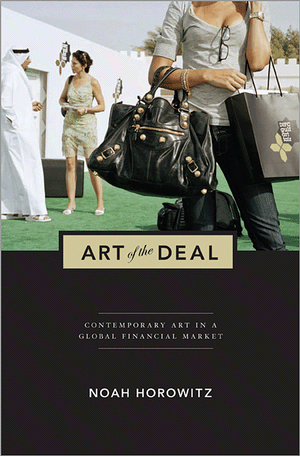
Book review - Art of the Deal: Contemporary Art in a Global Financial Market


cremaster4_ss_03_0.jpg
Matthew Barney, Cremaster4. Photograph Michael James O'Brien © Matthew Barney

Money and art. What's not to like? Most of the works i write about on the blog have very little to do with art speculation, auction houses and investments funds but that doesn't mean that i'm not curious about the myths and mysteries of the art market. I've read a few books on the subject over the past few years. Sarah Thornton's Seven Days in the Art Worldwas widely praised in art magazines but the author's palpable apprehension of causing any discomfort to the very world she belongs to was a bit off-putting. Don Thompson's The 2 Million Stuffed Shark: The Curious Economics of Contemporary Artis far more candid and fearless. Its purpose, i think, was to be a kind of Freakonomics of the art world. The book sometimes went for the spectacular and the obvious but it was entertaining, informative, unconceited and a nice introduction to the subject. Ben Lewis' DVD The Great Contemporary Art Bubble DVD(trailer this way!)wasn't afraid to ruffle a few feathers and to use sensationalism as an excuse to engage viewers into though-provoking reflections.

Art of the Deal is in a class of its own. Like Seven Days in the Art World, it was written by an insider. Noah Horowitz is a member of the faculty of the Sotheby's Institute of Art in New York and the Director of the VIP Art Fair - the first-ever exclusively online art fair. Horowitz, however, doesn't confuse respect for the art world with blatant kowtowing. He even manages to be critical without falling into the cynical trap.

The merits of the book do not stop there.

It opens where every recent book about the contemporary art market starts: Damien Hirst and an auction that has its own wikipedia entry. But it then ventures into territories left untouched by other authors of similar essays. Instead of talking Murakami paintings and Koons sculptures, Horowitz approaches more 'immaterial' genres which, despite their popularity in art galleries and biennales, tend to get far less attention from collectors and auction houses: video and 'experiential art' (performances, installations, action art... any art form that focuses on experience and social interaction.)

parreno_press_2.jpg
Philippe Parreno, Invisibleboy, 2010. Film Still. © 2010 Gautier Deblonde

ef0c7701-7ec4-4c5e-a394-fca522cbf2da--00000--2.-Invisibleboy-Press-page.jpg
Philippe Parreno, Invisibleboy, 2010. Film Still. Courtesy of Air de Paris, Courtesy of Centre National des Arts Plastiques, © 2010 Philippe Parreno

I learnt something at almost every single page of the book: the way videos and their ancillary goods drive the art market, how Barney financed the Cremaster Cycle, issues of content ownership, the rise of the collector's box, the 'experientialization' of the global art world, the difference between prestige buying and investment in art for financial return, what collectors acquire exactly when they purchase a "constructed situation" by Tino Sehgal, an artist who doesn't create tangible works, doesn't issue press releases, refuses to throw opening parties and doesn't allow photo documentation of his work.

tiravanijapadthai91-96.jpg
Rirkrit Tiravanija, Pad Thai, 1991-96

Horowitz doesn't generalize, nor does he simplify facts. His conclusions are prudent and well-balanced. He bring economics and art together like no one has done before (as much as i can tell.) Perhaps more importantly, the author doesn't live in an hermetically closed contemporary art bubble. He has read Geert Lovink, he (briefly) takes into account artists who -whether by choice or fate- do not sell their works, drives parallels with the commercial music and film industry, doesn't throw daggers at ubuweb and even sees youtube and other online video platforms as 'providing new opportunities and challenges for future developments of exhibiting and collecting standards.;

Art of the Deal is dense, impeccably researched, its language is clear, its insider stories come fast and numerous.

Horowitz doesn't touch upon the delicate issue of the market for new media art but my next review might have more about the subject.

Followers