This is Phil, he's teaching English online for free. He's great, the comments below thanking him or accusing him of being stupid are even better.
Saturday, March 24, 2012

Accent and Muscles
Another post from www.antimoon.com:
Tue Apr 11, 2006 12:28 pm GMT
Is it impossible to a person to speak like a native??
What is the difference between the american's mouth and the english learner's mouth??
Americans have different sound and that sound is the important thing..
I think it is something possible because I've seen people like Shikeh Hamza Yusuf, an american muslim talks arabic like a native and also I've seen another person I thought he is arabic and then I figured out that he isn't arabic, I thought he was arabic because he talked just like an arabic despite he is an indian, I was shocked, how did he talk like an arabic does!!
Accent and Muscles
This is a post from www.antimoon.com, a website for 'How to learn English effectively'.
This is a post from a forum about pronunciation and mouth muscles. It is an answer to a question about how long it might take for a person learning English to get rid of their native accent to accommodate their idea of proper English.
Tue Apr 11, 2006 4:42 am GMT
The muscles of articulation are all used for all languages. If you have trouble with pronunciation, it's psychological, not physiological. Your muscles will articulate all sounds correctly if your brain tells them to.
You aren't Asian by any chance, are you? Asians are particularly prone to bizarre beliefs about muscles and tongue movement and other imaginary physical obstacles to correct pronunciation. I understand Koreans even undergo useless surgery in an attempt to improve their English pronunciation.
Anyway, eliminating a foreign accent is always possible, but it requires a lot of conscious effort. Studying phonetics can help a lot. Practice makes perfect.
Many people are able to SING without an accent. I haven't found a satisfactory explanation of this, but one possibility is that a different part of the brain participates in singing, and that it is better at imitating unusual sounds than the part that handles ordinary speech. But that's just conjecture. The fact that people can sing without an accent does demonstrate that it's not a question of muscles, though.
Some people are indeed very good at producing unfamiliar sounds. I have some students who can immediately pronounce something in English without an accent (although doing this consistently and instinctively in normal speech requires practice), and others who cannot produce unfamiliar sounds even after hours of effort.
People with open minds and an attraction to novelty seem to do better on pronunciation.
People who strongly identify with their language and are afraid of new things do worse.
People who are afraid of sounding "stupid" have a lot of trouble with pronunciation.
Neanderthal Voice Theory
Vocal experts examine the first full skeleton of a neanderthal ever to be discovered and uncover insights into the most likely sound our primitive cousins would have made. Interesting short video from BBC show 'Neanderthal: The Rebirth'.
Thursday, March 22, 2012
Richard Tuttle interview
http://bombsite.com/issues/41/articles/1580
about space creating work, naming pieces after places...
i was looking for a quote by tuttle about the light in new mexico i think.... which i'll never find again.
Monday, March 5, 2012
Florian Graf
Project for Cumbernauld Hit, 2009. In a temporarily vacant shop in the shopping center of Cumbernauld, Florian Graf installed a fake estate agency. As an agent, he held conversations with local passersby, discussing their dreams and ideas for the city’s future. The properties displayed for sale echoed the architecture of Cumbernauld and its 20th century modernist intentions.

Sunday, March 4, 2012


Saturday, March 3, 2012

Tuesday, February 28, 2012
Tara Donovan
Tara Donovan’s Brilliant Drawings Made of Thousands of Pins

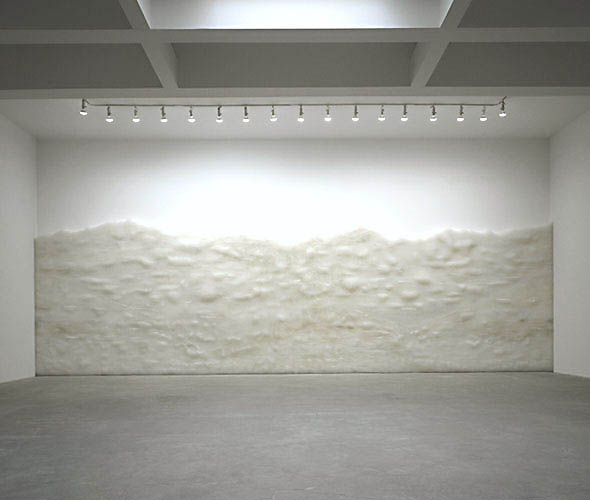
A STUNNING DEPARTURE FOR AN ARTIST SAINTED BY THE MACARTHUR FOUNDATION’S "GENIUS GRANT."
Viewed from afar, Tara Donovan's artworks often look like massive pieces of moon-scape, dropped straight from space into a pristine white gallery. It's only when you draw closer that you realize these pieces aren't alien at all: They're made of simple, everyday stuff, whether it's thousands ofpencils or coffee cups or drinking straws gathered into hills and clouds occupying entire rooms. Donovan, a certified MacArthur Foundation genius, is the closest thing the art world has to a true alchemist, transforming the detritus of everyday life into sheer beauty.
In her latest show, at Pace Gallery in New York through March 19th, Donovan departs from her usual formula of sculptural installations that take up entire rooms. Instead, she's using thousands and thousands of push-pins to create images up to eight-feet tall. Viewed in person, the pieces shimmer and dance; formally, they look like homages to minimalist gods such as Agnes Martin or Kasimir Malevitch.
But where those works can be chilly and almost devoid of a human touch, you can't help but feel Donovan's hand in these pieces, meticulously pushing each one of those pins into place, backing up to gauge her work, and starting all over again.
Here, we present a slideshow of her works. But if you're in New York, you gotta see these for yourself.
Wednesday, February 22, 2012

Monday, February 20, 2012
Brody Condon
(1) Each pole must stay connected at all times, creating a line of energy the length of the poles.
(2) The movers should move slowly and constantly in a circle, like a blender with the center dancers swirling in place. They should imagine this movement to be the engine of a Dimensional Stability Machine, if the machine stops our dimension evaporates.
(3) Any viewers are to be regarded as ghosts on another plane of existence; they can be seen but not touched or spoken to.
Tuesday, December 6, 2011
tower blox - BBC 25 November 2011
Viewpoint: Could people learn to love tower blocks?

1945 saw Britain as victors and victims - lost men, lost skills, lost industry, and, most significant, a critical shortage of homes.
Once tower blocks were the answer to a housing crisis but many people came to hate them. With Sheffield's Park Hill estate being refurbished for its 50th birthday, can people learn to love them again, asks architect and broadcaster Maxwell Hutchinson.
The new Labour Prime Minister Clement Attlee was a democratic victor but a scapegoat for government's failure to come up with solution to the critical homes crisis.
Homes were the most pressing and seemingly insoluble of all post-war social issues. There was no labour force, no bricks, and acres of still-smoking slums.
Enter continental pre-war modernist architecture, forged in the creative minds of Le Corbusier, Walter Gropius and others, and kept alive in the fertile minds of Britain's young architects, who had been plucked away from their studied enthusiasm for the new modernism to fight a war.
They returned, not demoralised by the fighting, but with a fervent zeal for modernism. They brought with them a solution, and government loved it. Housing problem? What problem? Build them high, make them in factories, and slot them into the waste lands of easily cleared slums.
There were no Nimbys [not-in-my-back-yard] then. No pressure groups, no conservation areas - British towns and cities were one huge brownfield site.
So the British tower block was born. Glasgow rebuilt a city with more tower blocks than any other city in Europe. It's still the case. London's East End cheered as cloud-scraping towers provided modernity, inside lavatories, central heating, Formica, and hot baths.
 Tower blocks were the answer to a major housing crisis
But this vision did not last long. The middle class saw tower blocks as ghettos that they would rather pass by. Post-war families boomed, but the ideologically inspired dreams of cheap, quality, high-rise housing started to be neglected and demonised.
The tower block started to be seen as all that was misguided about post-war Britain. Maintenance was often abysmal - lifts failed, rubbish chutes were blocked, garages were burnt by vandals.

There had been doubts, but events triggered by an early morning cup of tea in a tower block in east London on 16 May 1968 turned the UK wholeheartedly against high-rise living and all that it stood for.
Ivy Hodge lived on the 18th floor Ronan Point, a 22-storey tower, named after Harry Louis Ronan, a chairman of the London borough of Newham's Housing Committee, which had opened on 11 March 1968.
As Hodge struck a match to light her stove, a gas explosion ripped the corner out of the tower. That corner fell down like a pile of loosely stacked tiles.
That was how the block and many more like it were built, story-high, load-bearing concrete panels stacked sky-high with what proved to be appallingly badly made joints. Hodge survived but four residents died and 17 were injured in the disaster.
Hodge's cup of tea had brought down more than the corner of one tower - it shattered the public's confidence in all high-rise dreaming.
The innate enthusiasm of the English for vernacular architecture took hold of the nation's mood - all would now be comfortable brick, near the ground with pitched roofs, garden front and rear. It would be just like good old England.
Such was the government's over reaction at the events in Newham that they tore up their high post-war ideals and started an orgy of tower destruction.
The undeserved perception of failed idealism was celebrated by spectacular displays of demolition pyrotechnic. The tower block had failed and picnic parties sat on London's Hackney Marshes as tower after tower exploded and crashed into a pile of wasted idealism and dreams.
But all was not lost. Some energetic and visionary young architects and property developers have seen merit in the towers in the 21st Century.
Many of the old towers are still there - their very existence proving they are intrinsically sustainable. A tidy-up of the common areas, new lifts, a permanent concierge, entry-phone system and high-rise slums could become desirable homes.
London's famous Trellick Tower, by the architect Erno Goldfinger, is now a 30-storey style pile. That goes for towers in Glasgow, now swathed in multicoloured insulating overcladding.
Not all concrete ideals of the post-war building boom have survived, Alison and Peter Smithson's polemic Robin Hood Gardens in east London is not long for this life, despite the protestations of the architectural elite. Concrete cancer, poor maintenance and the vandalism of social discontent have had their way - down it will come.
But there is nothing intrinsically flawed with the idea of high-rise living. Sustainability, good maintenance, careful management and a sense of ownership can make things work.
If the lift works, towers are particularly suitable for the elderly - great views, peace and quiet, neighbours who can still remember the post-war devastation.
Towers also work for the young - they are convenient, give a good leg-up on the housing market, and, with good neighbours, great fun. There is plenty of time to have children and move into a predictable estate on the outside of town. In the meantime, one can enjoy life with one's head in the clouds.
The tower of homes is making a refreshing comeback. New technology means faster, more reliable lifts, and acoustic improvements mean greater privacy.
 There is now a new generation of high-rise
New materials and structural engineering innovations produce a new architectural language for the tower. Although concrete is still an essential part of the buildings' structure, it is no longer a singular cladding material.
The new towers benefit from the introduction of colour and texture. The tower prejudice has all but gone - today's urban world is once again reaching for the sky.
Monday, November 28, 2011
Holy Grail Obstacle Course
My first proposal for a reenactment:
Plan for Crit
In the next few weeks I would like to host a reenactment of a sequence of scenes from Indiana Jones and The Last Crusade. The scene is the pinnacle of the film where Indiana Jones, his father Henry Jones, his colleague Marcus Brody and their associate Sallah reach the final resting place of the Holy Grail. Along with the desire of the Holy Grail of the Nazis, and to save his father’s life, Indiana Jones is forced to proceed along the ancient obstacle course set in place to deter pilgrims of the Grail quest from obtaining the eternal life giving cup. Through careful research and study over the years, his father has acquired a number of vague clues to successful passage through the tests and traps set in place to kill contenders.

For this crit I am presenting an edited clip of the scenes, and an installation of the props I will use in the lo-tech reenactment. This will include some round cardboard blades covered in tinfoil, a floor plan of letters, a lion’s head and sesame seeds.I would like to host this reenactment in the basement of the Vic. I will use the lighting to stage a certain filmic quality, and the music technology and a projector to play the edited version of the scenes during the reenactment. I will invite classmates, other students, and anyone in the Vic that day to participate in the crowd or to be one of the contenders. The participant who ‘runs the obstacle course’ has the choice to wear an Indiana Jones style hat, and can stick to the script of the film, using prior knowledge of the film, or with the help of the projection, or they can interpret the course as they like.
This piece will hopefully allow me to progress my experience of the issues surrounding participation, as I will act as director in so much as I will install the course, but the participants will be free to choose how to use the course.
Potential Problems on the day:
- No-one will come, (I plan to put up posters, see poster)
- I will find difficulty explaining to participants, esp if several people, what my intentions are, as I am not yet sure
- The scene which lasts about 8 minutes might be too long to hold the attention of the participants. (editing would have to consider the most relevant scenes detrimental to the execution of the exercise)
I have previously been preoccupied with the idea of working outside the school, with already formed groups, especially in non-art areas. However, while still within the art school, I have decided that it would beneficial to take advantage of the supportive, open and enthusiastic world that the school provides, and strip my practice back to the experimental stage.
Documentation
I plan to either film this myself or ask someone with better skills and/or camera to film it for me. I think I may have to do the course myself, I’m not sure if some participants will let me get away with not doing it. Although this is not a performance, and I would rather not blur the lines of intention. I will also use photography as I hope the course will be run more than once, so I will have opportunity to film and photograph. I am aware that sound is particularly difficult to capture in a large space with lots of people, so I will need to borrow a sound recorder form EMS. I am not sure if I would attach it to each contender as they run the course or not.
In an exhibition situation, I would show this work without the props, and on two screens. One screen would be the original film, one would be the footage I make alongside, with the audio at the same place. The footage film may be partly or all stills, depending on the quality of the filmed footage.
Please take part in:
HOLY GRAIL
OBSTACLE
COURSE
Inspired by Indiana Jones and The Last Crusade
Downstairs in The Vic
TIME, DATE, Clare Marks
Subscribe to:
Posts (Atom)